
Creative-office and Class A buildings in the Santa Monica area have genuinely different cleaning requirements, and most vendors discover that gap the hard way after their first service week. Santa Monica's Silicon Beach corridor runs from the Water Garden to the Pen Factory, and those campuses are packed with media, tech, and entertainment tenants whose workplace standards are shaped by some of the most demanding corporate customers in southern California. ISSA 2026 benchmarks put commercial cleaning rates for Class A offices at $0.12 to $0.18 per square foot per month, but the scope at a Santa Monica creative campus routinely runs deeper than what that rate covers at a generic suburban office park. A high-quality, comprehensive office cleaning service for facilities like these starts with understanding what makes them different from a standard apartment complex, retail site, or gym.
What Makes Santa Monica Creative Office Space Different
The workplace itself becomes more complex to maintain when exposed ceilings, polished concrete, and glass walls replace standard office finishes. Creative offices replaced drop ceilings and cubicle farms with exposed ductwork, large open collaboration zones, and glass-walled conference pods. Those material choices look sharp, but they each carry a cleaning challenge that a standard janitorial services spec doesn't address by default.
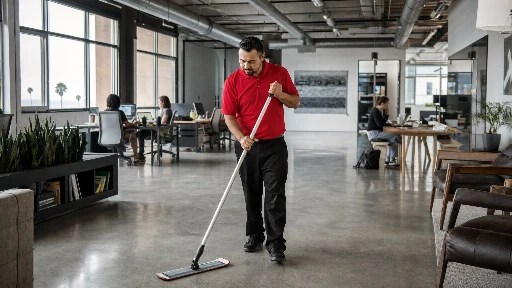
Polished concrete is maintenance-intensive. Foot traffic abrades the surface finish over time, salt air from the coast accelerates oxidation at the micro level, and most cleaning teams don't know that wet mopping polished concrete with the wrong cleaning products strips the sealant and creates a dull haze that spreads fast across large open floors. The correct protocol is a neutral-pH cleaner, a microfiber flat mop, and a moisture-controlled application that doesn't leave standing liquid. That's a product specification and a training issue, not just a technique preference.
Exposed ceilings collect more particulate than finished ceilings do. Ducts, beams, and cable trays are visible, which means dust accumulation is a tenant complaint waiting to happen, especially in buildings where founders and executives work on the floor alongside their teams. Periodic deep cleaning of exposed structural elements is a task that must be scoped into the contract, not treated as a discretionary add-on. Building maintenance schedules that include high dusting keep those surfaces under control without requiring disruptive shutdowns.
The Marine Layer and Coastal Air Quality Factor
Santa Monica's coastal environment creates an indoor air quality variable that most cleaning vendors based further inland don't account for. Marine layer humidity, salt particulate, and the concentration of VOCs from interior finishes combine to accelerate surface soiling and affect air quality in ways that can trigger tenant complaints even in otherwise well-maintained spaces.
Buildings within a few blocks of the ocean see measurably faster soiling on glass surfaces, exterior-facing window ledges, and HVAC vent covers. A weekly glass-cleaning schedule that works fine at a Century City tower may fall a week behind in a Santa Monica building facing the water. The right vendor builds coastal proximity into the service frequency model, not into a change order after you've already started getting complaints. Consistent monitoring of those surfaces is the only reliable way to stay ahead of the soiling cycle.
HVAC filter maintenance matters more here too. Many Santa Monica facility managers have made quarterly filter checks part of their standard operating procedures because tenant satisfaction in creative campuses correlates strongly with air quality perceptions. A vendor who can ensure HVAC-adjacent cleaning tasks are safely covered on a defined recurring schedule adds real value in a coastal facility.
Santa Monica Cleaning Service Standards for Class A and Creative Offices
Class A cleaning in Santa Monica isn't significantly different from Class A cleaning at a Century City or Playa Vista tower in terms of the base standard. What's different is the tenant mix and what those tenants care about day to day.
A traditional Class A tenant in a financial district building cares about lobby presentation, conference room readiness, and discreet restroom maintenance. A Class A creative tenant in Santa Monica cares about all of those things and also about the cleaning products being used in their space, the sustainability profile of the vendor's operations, and whether each cleaning task is performed by courteous, professional staff who don't disrupt the workday. That last point sounds soft, but it shows up in practical terms: creative tenants are more likely to flag product fragrance, report a cleaning product that affected their employees, or notice that equipment was left blocking a collaboration space for an hour.
Green Cleaning and Product Requirements
Santa Monica's green building stock is significant. The city has been aggressive about LEED certification for commercial construction, and many landlords require that service vendors use Green Seal certified or equivalent non-toxic cleaning products as a condition of their building services contract. That requirement appears in leases and service specs more frequently in Santa Monica, CA than in most other LA submarkets.
At the practical level, this means your cleaning vendor needs to stock and use low-VOC, biodegradable cleaning solutions and fragrance-free formulations. The ability to customize cleaning products for specific tenant requirements, and to handle waste responsibly, separates vendors who understand this market from those who don't. That's not aspirational language for a pitch deck. It's the actual product list that goes into the service spec, and it's what some landlords and tenants will audit.
Electrostatic disinfection and hospital-grade disinfectants are a separate question. Creative tenants often have more sensitivity to chemical exposure in shared spaces than traditional office tenants do, so the disinfection protocol needs to balance efficacy with product choice. Low-residue, quaternary-ammonium alternatives can be safely used in high-touch creative office common areas and are more appropriate than heavy bleach-based formulations, particularly in spaces where teams gather and food is prepared or served.
Open-Plan Cleaning Without Disrupting Workflow
The open-plan creative office creates a staffing and scheduling challenge that cubicle environments don't have. There's no obvious perimeter to clean around. Teams spread across large floor plates without walls, which means your cleaning crew is always operating in someone's direct sightline and earshot when they're present. Vacuum noise, product smell, cart noise, and conversation between crew members all become friction points.
The standard solution is after-hours service, but Santa Monica creative tenants push back on that harder than traditional tenants do. Many creative organizations run flexible hours, which means early morning and late evening are not guaranteed to be empty. Some teams work until midnight on launch weeks. The service schedule needs to be genuinely flexible, which requires a vendor with good account management and crew scheduling discipline.
Pro tip: Before you finalize a cleaning schedule for a creative campus, ask your new vendor to do a one-week occupancy audit. Have them track actual building usage patterns for one week before setting service times. The data almost always reveals one or two floors with unusual late hours that would otherwise cause a service disruption in the first month. Any cleaning business with real account management experience will accommodate that request without pushback, and will arrive with proper equipment and trained staff who know how to work efficiently in open-plan office space.
What the Day Porter Role Looks Like in a Creative Building
Day porter service is more critical at creative campuses than at traditional office buildings, and it's also more visible. A day porter in a creative Santa Monica building is part of the common-area building maintenance team, the first-impression ambassador for shared spaces, and the person tenants call when something goes wrong mid-day. That role requires a different profile than a standard janitorial tech.
Common day porter responsibilities at Santa Monica creative campuses include: continuous lobby and reception area monitoring throughout the day, conference room turnover between meetings (wipe, reset, restock), common kitchen and breakroom maintenance on a two-to-four-hour cycle, restroom checks and restocking on a scheduled frequency, and rapid-response spill and incident handling. Setting up recurring services for these tasks, with documented frequency and accountability, is what separates a professional cleaning service from ad hoc coverage. At campuses with outdoor amenity areas, terraces, and collaborative outdoor spaces, the scope extends outside.
Matching Day Porter Staff to the Building Culture
Creative office tenants notice when the day porter team doesn't match the building's culture. That's not about aesthetics. It's about communication style, problem-solving approach, and presence. A day porter who proactively flags a graffiti tag on a stairwell door before the property manager notices it is doing their job. One who walks past it three times is creating a problem.
When you evaluate cleaning companies for a creative Santa Monica building, ask specifically how they train and retain day porter staff. The best vendors employ highly trained, background checked technicians who are reliable, friendly, and professional enough to represent your property in front of tenants every day. High employee turnover in the day porter role is a direct tenant satisfaction issue because tenants form a daily relationship with the people they see every morning. According to BSCAI research, labor accounts for 50 to 65% of a commercial cleaning company's operating costs, and vendors who invest in competitive compensation and retention show it in their consistent service quality. Ask any cleaner you're considering for references from properties where their day porter staff stayed on for a year or more.
Specialty Surfaces and Deep Cleaning in Creative Santa Monica Buildings
Santa Monica creative campuses tend to feature surface materials that standard cleaning protocols don't cover well. Unlike retail or residential cleaning environments, where a general-purpose cleaner handles most surfaces, corporate and creative office campuses in the Santa Monica area require a surface-specific protocol for each material. Here's how the most common ones break down.
Polished Concrete Floors
Weekly damp mopping with a neutral-pH cleaner and microfiber flat mop. Never use alkaline or acid-based cleaning products on sealed polished concrete. Avoid wet mopping in high-humidity coastal conditions; use a controlled-moisture technique that deposits a thin film rather than a wet layer. Annual or semi-annual burnishing with a proper concrete-safe pad keeps the surface finish consistent. Confirm your vendor's crew has done polished concrete before, not that they've "cleaned hard floors before." Those are different skill sets, and the wrong equipment can cause permanent damage.
Glass Partitions and Exterior-Facing Windows
Streak-free cleaning of interior glass partitions requires a two-step process: a water-fed microfiber system or a low-residue glass cleaner followed by a dry buffing pass. In a coastal building, high-touch glass partitions may need twice-weekly attention to maintain the standard. Exterior window washing on a salt-air exposure should be spec'd at minimum monthly. A quarterly schedule at a Santa Monica oceanfront building is not adequate. A professional cleaning technician with coastal building experience will know the right schedule for your specific exposure.
Carpet, High-End Finishes, and Other Specialty Materials
If the property has carpet in common areas or private offices, the cleaning spec should address it separately from hard-surface protocols. Carpet in a coastal environment traps salt particulate and humidity-related odors faster than inland buildings, so frequency and method both matter. Periodic deep cleaning via hot-water extraction is the standard for a Class A building or business that wants to satisfy tenant expectations year-round.
Creative lobby finishes in Santa Monica buildings often include custom tile, poured resin surfaces, engineered stone, or decorative metal. Each requires a surface-specific cleaning agent, and using the wrong product even once can cause permanent damage to a finish that costs $60,000 to restore. A good vendor walks the building with the property manager before the first service date and flags every specialty surface for a specific product protocol. That walk-through documentation becomes part of the service spec.
How to Find a Reliable Office Cleaning Service in Santa Monica
Whether you're managing a commercial real estate portfolio or a single corporate campus, the selection process for a creative Santa Monica, CA building should be more demanding than a standard commercial cleaning RFP. Here's what to look for when you hire a professional cleaning company for this market.
Ask for polished-concrete and specialty-surface references specifically, not general commercial references. Request documentation of what green cleaning products they're currently using and whether those products carry Green Seal or comparable certification. Confirm their day porter staffing model and turnover rate for the prior 12 months. Ask whether they've worked in LEED-certified buildings. Ask whether the crew is licensed, insured, and background checked, and verify the vendor holds a current business license. A vendor's reputation in the santa monica cleaning market matters: ask for references from similar creative-office properties and follow up on them.
Vendors who specialize in the santa monica area and similar coastal submarkets know what those complexities cost to get right. When you request a quote, make sure the scope document is detailed enough to compare bids accurately. When you hire a cleaning company for a creative campus, base the decision on their track record with buildings like yours, not just their price per square foot.
On pricing: the $0.12 to $0.18 per square foot benchmark applies to standard office cleaning. A creative campus with a day porter, specialty surfaces, non-toxic cleaning products, and flexible scheduling will typically land at the higher end of that range or slightly above it. Vendors pitching at the low end for a complex creative campus are either missing scope in their proposal or planning to cut corners after the first 90 days.
MNZ Commercial Cleaning Services has been serving santa monica cleaning accounts and commercial properties across the Los Angeles, CA region since 1979. Our expert teams specialize in creative campuses, Class A office towers, and mixed-use facilities, and we customize service programs to satisfy the specific requirements of any building or business in the area. As the professional cleaning service santa monica facility managers and real estate teams rely on for consistent, recurring services, MNZ is structured for commercial accounts: our staff is highly trained, insured, background checked, and equipped for the full scope of janitorial services in southern California. We're familiar with coastal building dynamics, non-toxic product requirements, and the day porter service model that creative tenants actually expect.
Frequently Asked Questions
Do Santa Monica office buildings require green cleaning products?
Many do, particularly buildings with LEED certification or sustainability requirements written into tenant leases. Santa Monica has one of the highest concentrations of LEED-certified commercial buildings in the LA region, and the city's building codes have encouraged sustainable operations since the early 2000s. Before signing a service contract, confirm whether your building or any tenants have written product requirements. Green Seal certified cleaning products are the most commonly cited standard, and most professional cleaning vendors operating in this market stock them as a baseline rather than as an upgrade. Any insured, reputable provider will supply product documentation on client request.
How often should glass surfaces be cleaned in a Santa Monica building?
Interior glass partitions at a high-touch creative office should be on a weekly schedule, with twice-weekly cleaning for lobby glass and reception areas that see heavy traffic. Exterior-facing windows need more frequent attention than inland buildings due to marine layer deposit and salt particulate. Monthly exterior window washing is a workable floor; quarterly is not adequate for most Santa Monica buildings facing the water or near the coast. If your current schedule is producing consistent tenant complaints about streaked glass, the frequency, not the cleaning products, is usually the issue.
What's the difference between janitorial services and day porter service for a creative building?
Janitorial services covers the overnight or after-hours scope: vacuuming, restroom deep cleaning, trash removal, and floor care. Day porter service is on-site presence during business hours for continuous maintenance, rapid-response incidents, conference room turnover, and lobby upkeep. Creative campuses almost always need both. A building that relies on overnight janitorial only will have a visible drop in common-area quality by mid-afternoon on a busy day, and creative tenants on those floors will notice. Day porter coverage doesn't have to be full-time at every campus, but some level of daytime presence is standard for any building where employees are in the office from 8 a.m. to 8 p.m.
How should a vendor handle cleaning during after-hours creative office events?
Creative tenants host launches, client events, and team gatherings regularly, and those events create a cleaning scope that sits outside the standard service spec. The right approach is a written event-cleaning addendum in your service contract that defines how additional scope gets triggered, staffed, and billed. Ad hoc requests handled verbally create billing disputes and service gaps. Ask your vendor how they've handled event support for other creative tenants and whether they have a standard event-cleaning protocol they can walk you through before you sign.
If you're managing a creative office building or mixed-use campus in Santa Monica, CA and want expert guidance on service in santa monica for your specific building type, call MNZ Commercial Cleaning Services at (818) 480-9316 or visit mnz.com. We've been serving commercial properties across Los Angeles since 1979 and can put together a proposal based on your actual building, not a generic template.
Related Reading
Transform your space into a clean and welcoming environment with MNZ. Contact us today to schedule a consultation and get a quote for our professional cleaning and maintenance services.
.jpg)


